Pre-Shower Makeup: There is a very specific kind of evening that every makeup lover knows. You are standing in your bathroom, shower already running, and for reasons you cannot fully explain — you reach for your eyeshadow palette.
You blend out a smokey eye you have no plans to wear anywhere. You try the bold graphic liner you have been scared of. You smudge on liquid blush until your cheeks look like a cartoon character. And then — you step into the shower and wash it all off.
Turns out, you have been doing “pre-shower makeup” long before it had a name.
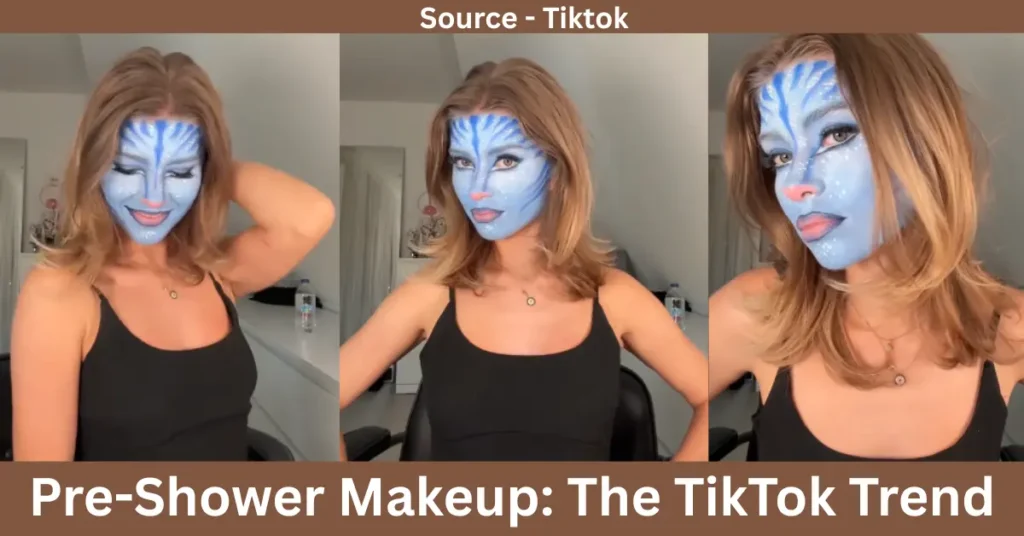
This is exactly the trend that has taken over TikTok — and what started as a niche hashtag has now grown into a full-blown movement that touches on creativity, mental health, skill-building, and the simple, underrated joy of doing something purely for yourself.
With over 17,000 posts under #preshowermakeup on TikTok and millions of views across beauty communities worldwide, pre-shower makeup is not just a trend. It is a ritual. And if you have not tried it intentionally yet, you are genuinely missing out.
Read Also: Seint Makeup Reviews: Is It Really Worth the Hype?
What Is Pre-Shower Makeup, Exactly?
Pre-shower makeup is exactly what it sounds like: you apply a partial or full face of makeup right before you jump in the shower, with zero intention of going anywhere.
You do it, you admire it (or laugh at it), you take a photo if it turned out well — and then you wash it all off.
That is it. No event. No audience. No pressure.
Celebrity makeup artist Natalie Dresher described it perfectly: “Pre-shower makeup is when you do a fun or bold look right before you shower so you can experiment in a stress-free environment with no pressure.” Her colleague, celebrity makeup artist Allison Kaye, added that she taught herself winged eyeliner this exact way — practicing on herself before every shower for months, until she had it down. What the beauty industry once called “practice runs,” Gen Z has now formally christened a trend — and honestly, it is about time.
The looks people create range wildly. Some go for that winged liner they have been too nervous to wear in public. Others try contouring techniques, heavy blush placements, bold lip combos, or graphic cut-crease eyeshadow looks.
And then there are those who go completely off-script: covering their entire face in liquid blush, recreating Avatar-inspired face paint, or putting lipstick on their eyebrows just because no one is watching and nothing is stopping them.
How Did This Trend Start?
Pre-shower makeup as a named trend began picking up serious traction on TikTok around late 2023, though the behavior itself is far from new. Women have been sneaking into their mothers’ makeup bags to “play” with products since childhood — what pre-shower makeup does is give that same energy a formal framework and a hashtag.
The trend spread rapidly through TikTok’s beauty community, with creators in the UAE playing a particularly notable role in pushing it into mainstream beauty conversation. International beauty influencers with massive followings joined in, sharing their own judgment-free glam sessions.
By early 2025, publications like Glamour South Africa were covering it as “the ultimate girl therapy,” and dermatologists like Dr. Whitney Bowe had hopped onto TikTok specifically to use the trend as a teachable moment about proper makeup removal techniques.
The psychological timing of the trend also makes sense. Post-pandemic, many women reassessed why they wore makeup at all — shifting from performance for others toward something much more personal.
As psychiatrist Dr. Josie Howard noted when speaking to beauty media on the psychology of makeup use: the motivation behind wearing makeup matters enormously for mental wellbeing. Pre-shower makeup strips away every external motivation and leaves only one: you doing it because you genuinely want to.
The Real Reason It Feels So Good: The Psychology Behind Pre-Shower Makeup
This is where things get genuinely fascinating, and where pre-shower makeup earns its status as more than just a quirky trend.
It Removes the Fear of Failure
One of the biggest barriers to experimenting with makeup is the cost of getting it wrong. If you try a bold smoky eye on a Tuesday night before dinner plans and it looks chaotic, you have a problem. Pre-shower makeup eliminates this entirely.
You already know you are washing it off. That knowledge creates what psychologists call a psychologically safe space — an environment where the threat of judgment (even self-judgment) is low enough that creativity can actually flow.
Mental health therapist Jane Polinski, PLMHP, has spoken about how this kind of judgment-free self-expression directly supports identity formation and a healthier sense of self. “Allowing the space to express yourself gives you a sense of identity and personality,”
she noted in remarks shared across beauty and wellness media. When you are not performing for anyone else, you are forced to actually discover what you like — what colors feel exciting to you, what techniques feel right on your face.
It Functions as Genuine Mindfulness
Multiple studies have explored the intersection of makeup application and mental health — and the findings are meaningful. A 2018 study published in the journal Cosmetics found that when women applied makeup, they reported significant decreases in depressive mood states — with feelings of sadness, tiredness, and frustration all measurably reduced.
Research published in PubMed found a sustained positive relationship between regular makeup use and reduced depressive symptoms, noting that makeup engages three human senses simultaneously: touch, smell, and vision — making it a uniquely immersive sensory ritual.
Pre-shower makeup amplifies these effects. Because you have no deadline and no destination, the application becomes slower, more deliberate, and more meditative. You are not rushing. You are not checking the time.
You are entirely in the moment of blending and blending until something clicks — which is essentially what mindfulness practitioners have been prescribing for years, just with different tools.
Psychotherapist Oludara Adeeyo, a psychiatric social worker who has worked with trauma survivors, described makeup as a tool that restores a sense of agency and control.
When you feel like things in your life are out of your hands, taking full, autonomous control of something as tangible as your own face — even temporarily, even just to wash it off — can be quietly powerful.
It Reconnects You with the Joy of Play
There is a reason so many pre-shower makeup TikToks carry captions like “girlhood joy” and “like a child putting crayon to paper.” TikTok user @tramdoodles captured it perfectly with that line — and it struck a chord because it is true.
When you were eight years old sneaking into your mom’s eyeshadow, you were not thinking about technique or undertones or color theory. You were just playing.
Pre-shower makeup is the adult version of that. It is picking up a product and exploring it with zero agenda. Research on adult play consistently shows that creative, low-stakes experimentation reduces cortisol (the stress hormone), lifts mood, and improves cognitive flexibility.
Pre-shower makeup does all of this while also making you better at doing your makeup. It is genuinely a win-win.
What People Are Actually Creating: The Looks
The range of pre-shower makeup looks circulating on TikTok is enormous, but a few categories dominate:
Bold liner experiments are among the most popular — winged liner, graphic liner, floating liner, colored liner. These are techniques that require repetition to nail, and pre-shower is the perfect low-stakes practice ground. Celebrity MUA Allison Kaye literally learned her winged liner this way, practicing nightly before her shower for months.
Heavy blush and contour is another go-to. Liquid blush in particular has had a massive moment in recent beauty culture, and pre-shower makeup is where people really lean into the “too much” aesthetic — stacking blush from cheekbones to temples with complete abandon.
Some of the most viral pre-shower videos involve creators covering their entire cheeks, nose, and forehead in liquid blush, essentially turning their face red, and then laughing at the result before washing it all off.
Creative and fantasy looks sit at the more adventurous end — full body glitter, face gems, editorial liner art, avant-garde color blocking. Beauty influencer Brooke Monk recreated an Avatar-inspired look as a pre-shower session.
The beauty of this category is that you would never actually wear these looks out, which means pre-shower makeup is the only context in which most people will ever try them.
Trend testing is perhaps the most practical use: trying a specific TikTok makeup trend — the “soap brow” technique, a specific blush draping method, a two-toned lip — before committing to it in front of an audience. As Natalie Dresher put it: “Why would I risk it on a night I’m going out?”
Pre-Shower Makeup as a Skill-Building Tool: Does It Actually Work?
Yes — and the mechanism is straightforward. Any physical skill improves with repetition, and makeup application is no different. The problem is that most people only practice makeup in high-pressure moments: when they are going somewhere, when time is limited, when they cannot afford to start over.
Pre-shower makeup creates a consistent, low-pressure repetition environment. You can attempt the same contouring technique five nights in a row, washing it off each time, until your hands begin to intuitively understand the placement.
You can try blending your eyeshadow differently each time — more diffused, sharper, further out — and compare the results in real time without any consequences.
This is how professional makeup artists train, and it is how Allison Kaye taught herself winged liner. The shower acts as a clean-slate reset that makes daily practice effortless. You do not need to spend money on makeup remover (though you should still cleanse properly — more on that below).
You do not need to dedicate extra time to removal. The shower handles it, and you wake up the next morning with slightly better technique and no residual products on your skin.
For beginners especially, pre-shower makeup removes the intimidation factor from learning. You are not “wasting” product on a failed attempt — you are investing in practice.
The tube of liquid liner you have been scared to open? Open it. Your shower is waiting.
The Skin Care Angle: What Dermatologists Want You to Know
Here is where pre-shower makeup gets a responsible, informed caveat — and it matters for your skin health.
When you wash your face in the shower, you are not automatically removing all your makeup. Water alone, or even a basic facial wash, is typically not sufficient to break down makeup — particularly waterproof formulas, long-wear foundations, liquid eyeliners, and mascara.
These products are designed to resist water and friction, which is exactly why they survive a regular shower.
Leaving makeup residue on your skin overnight — even accidentally — is one of the more reliable ways to clog pores, cause breakouts, and accelerate skin aging. This is not alarmism; dermatologists are consistent on this point.
Dr. Whitney Bowe, who jumped on the pre-shower makeup trend specifically to address this, recommends a double cleanse approach:
First, apply a micellar water, cleansing oil, or cleansing balm before you get in the shower. These oil-based or micellar formulas work by dissolving and lifting the oil-based components of makeup from your skin without stripping the skin barrier.
Apply generously, massage for 60 seconds, and let it do the work of breaking down the majority of what you have applied. A cleansing balm is particularly effective for heavier, glitter-laden, or lash-glue looks.
Second, follow up in the shower with a gentle, water-based facial cleanser. This second step removes whatever the first step loosened, and also clears away any remaining surfactant or emulsified residue. Together, these two steps ensure your skin is genuinely clean — not just rinsed.
If you are planning to do pre-shower makeup regularly, the cleansing balm investment is worth it. Think of it as part of the ritual: applying it before your shower becomes a satisfying, almost ceremonial first step of the whole experience.
Products Worth Experimenting With During Pre-Shower Sessions
Pre-shower is the ideal moment to break in products you have been too cautious to use on your actual face for real occasions. Here are some categories that are particularly suited to pre-shower experimentation:
Glitter and chunky shimmer products are messy, difficult to remove, and almost impossible to wear subtly. Pre-shower is their natural home. The shower will catch the fallout, and a cleansing balm beforehand handles any adhesive residue.
Liquid blush is having its cultural moment, and pre-shower is where you figure out how much is too much on your specific skin tone and face shape — because that threshold is different for everyone and impossible to discover without actually trying.
Graphic and colored eyeliners require precision and practice. Pre-shower sessions give you the repetitions needed to stop drawing wings that look like two entirely different birds.
Bold lip combos — over-lined lips, ombre lips, editorial two-toned lips — are high-commitment in everyday life and low-commitment before your shower. Try the liner + lipstick + gloss layering you keep seeing on Pinterest. See if it works on your lip shape.
Contouring techniques like nose contouring, forehead contouring, and jaw sculpting are exactly the kind of high-learning-curve techniques that benefit most from practice. Pre-shower is where you experiment with placement without fear.
The Drawbacks: Being Honest About the Downsides
Pre-shower makeup is genuinely enjoyable, and we are not going to pretend otherwise — but there are a few honest drawbacks worth knowing.
Product usage and cost. If you are using expensive makeup — a high-end eyeshadow palette, a pricey liquid foundation — pre-shower sessions do use up product. This is worth considering.
You can absolutely do pre-shower makeup with more affordable, drugstore options and save your investment pieces for actual wear.
Removal time. If you go heavy — full glam, lashes, glitter, waterproof liner — removal takes more effort than a basic rinse. Budget an extra five to ten minutes for the cleansing balm massage pre-shower. This is not a dealbreaker, but it is worth knowing upfront.
Clogged drains. Heavy glitter and chunky shimmer products can accumulate in shower drains over time. This is a very minor consideration but worth noting for anyone doing frequent, heavy glitter looks.
None of these outweigh the benefits. They are just the fine print.
Pre-Shower Makeup and the Bigger Conversation About Beauty for Yourself
There is something genuinely meaningful happening beneath the surface of this trend, and it is worth naming.
For most of documented history, makeup has been framed as something women do for someone or something — for professional impressions, for romantic appeal, for social acceptability.
The growing cultural conversation around beauty autonomy pushes back on this framing, and pre-shower makeup exists almost entirely outside of the traditional performance logic. Nobody sees it. Nobody judges it. There is no audience. The only person it is for is you.
Research published in PureWow by psychiatrist Dr. Josie Howard captures this shift clearly: when makeup is worn as a form of self-expression and adornment rather than obligation, it actively supports a healthier sense of self and psychological wellbeing.
Pre-shower makeup is, almost by definition, makeup worn in the most internally motivated way possible.
It is also, as the TikTok comments consistently reflect, a surprisingly communal experience — ironically. The discovery that other people do this exact thing, in private, with no plans to go anywhere, has produced comment sections full of “learning other people do this just made my day” and “I’ve been doing this for years and I thought I was the only one.” There is something quietly beautiful about a private ritual becoming a collective one.
How to Try Pre-Shower Makeup: Your Starting Point
If you have never done this intentionally, here is a simple way to begin:
Pick one product you have been wanting to practice or experiment with — a liner, a blush, a contour stick — and pull it out before your next evening shower. No need for a full face. Start with one thing. Apply it, play with it, see how it looks, take a photo if you like it. Then get in the shower and let the water wash the whole thing away.
If you have a cleansing balm, work it gently across your face for about sixty seconds before stepping under the water. Follow with your usual facial cleanser inside the shower. Your skin will be clean, and your brain will feel oddly satisfied.
The more you do it, the more you will find yourself genuinely improving — at application technique, at product knowledge, at knowing instinctively what works on your face and what does not. Pre-shower makeup is one of those rare habits that is simultaneously silly and serious, frivolous and functional.
It is beauty with the pressure removed. And it turns out, that is exactly the version of beauty that feels the best.
Other Useful Links: The beauty of pre shower makeup
Have you tried the pre-shower makeup trend? Drop your experience in the comments — we want to know what looks you have been practicing when nobody is watching.
Priya is a dedicated skincare enthusiast and wellness researcher with over 10 years of experience in the beauty industry. She specializes in analyzing cosmetic formulations and simplifying complex skincare routines for everyday use. Through Glowvedas, she aims to empower readers with science-backed advice and honest reviews to help them achieve their most radiant self.